Choosing the right FBR Digital Invoicing software can be the difference between a smooth compliance rollout and weeks of engineering headaches. Pick the wrong tool and you waste money on per-invoice fees, pay developers to maintain integrations that should be turnkey, or end up locked into a contract you cannot exit.
This guide compares every realistic option for FBR Digital Invoicing software in Pakistan in 2026 — including PRAL direct integration, licensed integrators, and managed platforms. You will see the trade-offs of each, what to look for in features, what the real costs are, and how to migrate later if you choose wrong the first time.
For the full background on FBR's regulatory regime — SRO 709, Rule 150Q, deadlines, and penalties — read our companion guide on FBR Digital Invoicing rules and compliance. This post focuses on the software-buying decision.
For most businesses and tax consultants, a managed platform built on PRAL gives you free FBR connectivity plus a usable interface, multi-business dashboard, and ongoing support — without paying for engineering work.
What Is FBR Digital Invoicing Software?
FBR Digital Invoicing software is any application that performs four jobs in sequence: it generates an invoice in the structured JSON format FBR requires, transmits that invoice in real time to FBR through a licensed integrator (PRAL is the official one), receives the unique Invoice Reference Number (IRN) and QR code back, and prints the IRN and QR code on the invoice you issue to the customer.
Without one of these tools, you cannot legally issue a sales tax invoice in Pakistan if you are a notified registered person. Manual workarounds — Excel sheets, paper invoices, or generic invoicing apps not connected to FBR — are no longer compliant under SRO 709(I)/2025.
How FBR Digital Invoicing software differs from regular invoicing software
Generic invoicing tools like QuickBooks, Zoho Invoice, or Tally generate beautiful invoices, but none of them transmit data to FBR's servers in the format FBR expects. To comply with Pakistan's regime, your software needs three specific capabilities general-purpose tools lack:
- Direct API connectivity to FBR via PRAL using bearer-token authentication
- FBR-compliant JSON payload with the exact field structure FBR specifies (NTN, HS codes, tax breakdown, buyer type)
- IRN and QR code handling — receiving them from the API response and printing them on the final invoice
Who Needs FBR Digital Invoicing Software?
If you are a sales-tax-registered person notified by FBR, the law requires you to use FBR Digital Invoicing software. In practice, this covers most of the Pakistani business ecosystem:
- Corporate registered persons — mandatory since 1 June 2025
- Non-corporate registered persons — mandatory since 1 July 2025
- Public enterprises, importers, and large taxpayers (revenue > PKR 1B) — mandatory since 1 November 2025 under SRO 1852
- All other registered persons — mandatory since 1 December 2025 under SRO 1413
- Tax consultants and accounting firms — using software on behalf of their clients
If you fit any of these categories and have not yet integrated, you are accruing penalty exposure under Section 33 of the Sales Tax Act 1990.
Types of FBR Digital Invoicing Software
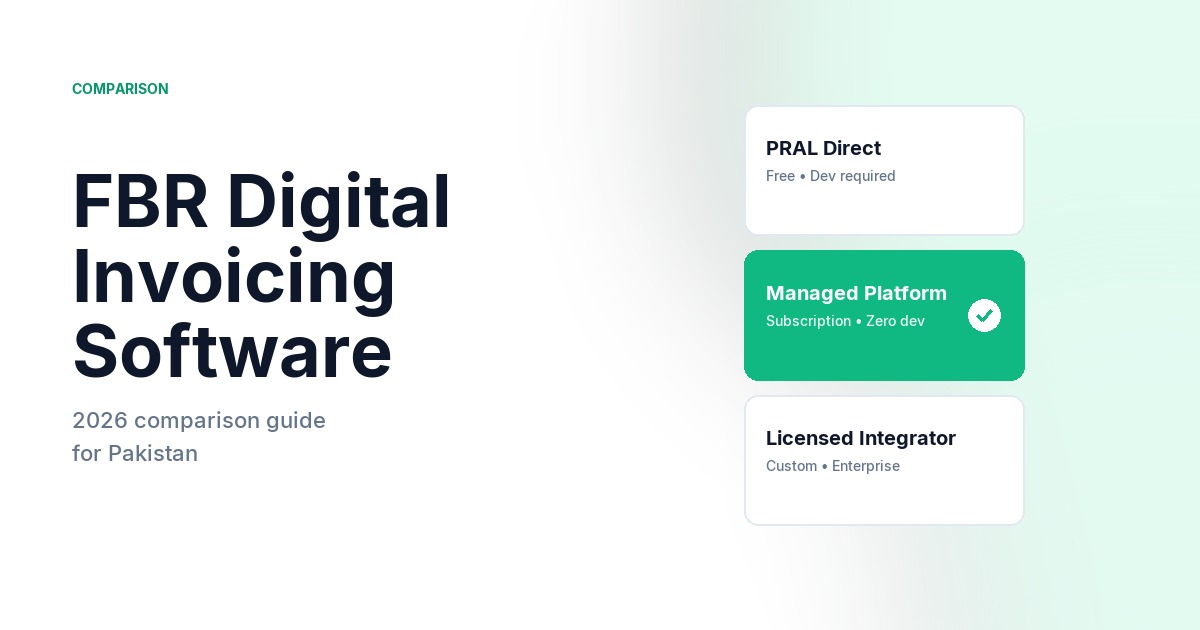
FBR Digital Invoicing software falls into three distinct categories, each with very different trade-offs.
1. PRAL direct integration
PRAL — Pakistan Revenue Automation (Pvt.) Ltd — operates FBR's Digital Invoicing API directly. Any registered person can integrate their own software directly with PRAL's API for free under Rule 150XF.
The catch: PRAL provides the API and documentation only. You write, host, and maintain the integration yourself. This typically costs 80 to 200 developer hours upfront, plus ongoing maintenance every time FBR updates the API (which it does several times per year).
2. Licensed integrators
Licensed integrators are companies that hold an FBR licence under Chapter XIV of the Sales Tax Rules 2006. They are authorised to configure registered persons' invoicing software for compliance. PRAL itself is a licensed integrator; there are several others operating in Pakistan.
Some licensed integrators sell their own software; others build custom integrations on a project basis. Costs typically range from Rs 50,000 to Rs 500,000 upfront, plus monthly or per-invoice fees.
3. Managed FBR Digital Invoicing software platforms
Managed platforms are SaaS products that sit on top of PRAL's free integration. They handle all the technical work, present a clean interface to the user, and typically charge a flat monthly subscription. Examples include Tallied, mydigitalinvoice.com, and several other Pakistani platforms.
This is the cheapest option for most businesses because the platforms use PRAL's free backend but spread their development costs across many customers.
If you have an in-house dev team, PRAL direct is free but takes months to build. If you have specialised enterprise needs, a licensed integrator gives you a custom build. For everyone else, a managed FBR Digital Invoicing software platform is the fastest and cheapest path to compliance.
Must-Have Features in FBR Digital Invoicing Software
Regardless of which category you pick, make sure the software you choose has all of these. Anything missing is a red flag.
| Feature | Why it matters |
|---|---|
| FBR API v1.12 compatibility | Older versions are deprecated. Anything below v1.10 will fail validation on new invoices. |
| Real-time submission | Batch processing is not compliant. Each invoice must transmit at the moment of issue. |
| All 28 sandbox scenarios supported | FBR requires you to pass every test case before going live. If the software does not handle Third Schedule goods, returns, or reduced-rate supplies, you cannot pass certification. |
| QR code generation | Mandatory on every invoice. Software must encode the IRN and print a scannable code. |
| 72-hour correction window | Per Sales Tax General Order No. 01 of 2026, invoices can be edited within 72 hours. Software must support this. |
| NTN / CNIC verification | Buyer verification against FBR's database prevents invalid invoices. |
| Bulk import (Excel / CSV) | Critical for tax consultants who process volume. |
| Per-business sandbox & production modes | If you serve multiple clients, each needs an isolated environment. |
| Queue and retry on FBR downtime | FBR's servers are not always up. Software must handle outages gracefully. |
| AES-256 encrypted token storage | Your FBR bearer token is sensitive credentials — should never be stored in plain text. |
| Audit trail | Every invoice action (issue, edit, cancel) should be logged for compliance reviews. |
| White-label / custom domain | If you serve clients under your own brand, this matters. |
How to Evaluate FBR Digital Invoicing Software Pricing
Pricing structures vary wildly across the market. Watch for the following models:
Per-business / per-NTN monthly subscription
The cleanest model. You pay a fixed monthly fee for each business you onboard. No per-invoice surprises. Wholesale tiers for tax consultants typically start around Rs 1,500 per client business per month; direct business plans usually start higher.
Per-invoice fees
You pay for each invoice transmitted. This can sound cheap upfront but punishes high-volume businesses. A retailer issuing 5,000 invoices a month at Rs 2 per invoice pays Rs 10,000 — more than most flat plans.
Setup / onboarding fees
Some providers charge one-time fees ranging from Rs 5,000 to Rs 50,000 for initial setup. These can be reasonable for complex enterprise integrations but are hard to justify for standard SaaS onboarding.
Annual contracts with discounts
Common pattern: 15–20% discount for annual prepayment. Good if you are confident in the provider; risky if you might want to migrate.
Hidden costs to ask about
- Fees for adding additional users
- Charges for API rate-limit increases
- Pricing changes when you exceed an invoice threshold
- Migration / export fees if you leave
- Support charges (some providers gate support behind paid tiers)
Skip the comparison shopping
Tallied offers transparent, flat per-business pricing with no per-invoice fees, no setup costs, and no commitments. Built on PRAL's free integration — you only pay for what you use.
Start Free Trial →Comparing FBR Digital Invoicing Software Options
Here is an honest side-by-side comparison of the main FBR Digital Invoicing software paths in Pakistan, based on publicly available information as of May 2026.
| Option | Cost | Best for | Watch out for |
|---|---|---|---|
| PRAL direct | Free (API only) | Companies with in-house engineering teams | 80–200 dev hours upfront; you maintain it forever |
| Tallied (managed, built on PRAL) | Wholesale Rs 1,500/client business; business plans launching soon | Tax consultants with multiple clients; small & mid businesses | Newer player — public reviews still building |
| Established licensed integrator (named providers vary) | Rs 5,000–25,000/month plus setup fees | Enterprises with complex ERP integrations | Higher cost; longer onboarding; possible per-invoice fees |
| Other managed SaaS platforms | Rs 2,000–8,000/month | Single-business owners | Mixed feature parity; verify v1.12 + 28 scenarios support |
| POS-integrated invoicing (retailer-specific) | Bundled with POS hardware | Tier-1 retailers running physical stores | Hardware lock-in; not suited for B2B services |
The right pick depends on your audience and volume. Tax consultants managing many clients benefit from a multi-business dashboard. Single B2B service providers benefit from a simple flat-fee plan. Tier-1 retailers running POS systems need invoicing tied to their point-of-sale hardware.
Common Mistakes When Choosing FBR Digital Invoicing Software
Mistake 1: Picking the cheapest option without checking feature coverage
A Rs 1,000/month tool that does not handle reduced-rate supplies or returns will cost you penalty exposure when you cannot file a credit note correctly. Verify every feature on the must-have list before saving Rs 500 a month.
Mistake 2: Buying enterprise software for a small business
If you issue 50 invoices a month, you do not need an Rs 25,000/month enterprise platform. The cost rarely pays back. Match the software's complexity to your invoice volume and team size.
Mistake 3: Ignoring multi-business support if you are a tax consultant
Most generic invoicing software assumes one business per account. If you serve five clients, you need five logins, five subscriptions, and five separate dashboards. A multi-business platform consolidates this into one workflow. The time savings alone justify the subscription.
Mistake 4: Not testing the sandbox properly
Some providers claim "FBR-integrated" but fail several of the 28 sandbox scenarios. Test before you go live — issue an invoice for Third Schedule goods, a credit note linked to a past invoice, and a reduced-rate supply. If any of these fail, walk away.
Mistake 5: Locking into long contracts without an exit clause
Software needs change as your business grows. Avoid annual contracts without monthly conversion clauses or migration assistance.
How to Migrate Between FBR Digital Invoicing Software Providers
One reassuring fact: your FBR bearer token from PRAL is the same regardless of which software uses it. Migrating from one FBR Digital Invoicing software to another is usually painless if both providers respect this.
The migration steps:
- Generate a fresh PRAL bearer token from IRIS for the destination software
- Export historical invoice data from the old provider (CSV or JSON is ideal)
- Configure the new software with the new token and sandbox-mode it first
- Pass all 28 sandbox scenarios on the new platform
- Switch to production and issue your next invoice through the new system
- Keep the old provider active for 7 days as a fallback in case of issues
Most migrations complete within 3–5 business days. There is no need to cancel invoices retroactively — historical invoices remain valid because the IRN belongs to FBR's system, not your software.
Free vs Paid: When PRAL Direct Makes Sense
PRAL direct integration is genuinely free. So when does paid FBR Digital Invoicing software make sense?
Use PRAL direct if:
- You have at least one full-time developer who can maintain the integration
- You issue invoices from a single ERP system that an engineer can wire up
- You are comfortable patching the integration each time FBR updates the API
- Your invoice format is straightforward (no reduced rates, no complex multi-currency, no third-party PSP integration)
Use paid FBR Digital Invoicing software if:
- You do not have in-house engineering capacity
- You manage invoicing for multiple businesses (tax consultants, accounting firms)
- You want managed support during FBR system outages
- You need a polished UI for non-technical staff
- You value the time saved on every FBR API version bump
For most Pakistani businesses, the maths favours paid software. A developer at Rs 100,000/month is more expensive than a Rs 3,000/month subscription that does the same job.
Try Tallied free
FBR Digital Invoicing made simple. Manage one business or many. Built on PRAL's free integration. No setup fees, no per-invoice charges, no commitments.
Start Free Trial →Frequently Asked Questions
What is the best FBR Digital Invoicing software in Pakistan?
There is no single best option. For developer-heavy companies, PRAL direct integration is free. For tax consultants managing multiple clients, a managed multi-business platform like Tallied minimises overhead. For enterprises with custom ERP needs, a licensed integrator with custom-build capability is appropriate.
Is PRAL FBR Digital Invoicing software really free?
Yes. PRAL provides free API access to registered persons under Rule 150XF. The catch is you must build, host, and maintain your own software that calls the API.
How much does FBR Digital Invoicing software cost in Pakistan?
It ranges from free (PRAL direct, plus your engineering time) to Rs 25,000+ per month for enterprise licensed integrators. Managed SaaS platforms typically charge Rs 1,500–8,000 per business per month.
Can I use generic invoicing software for FBR compliance?
Only if the generic software has built FBR Digital Invoicing capabilities (API connectivity to PRAL, IRN handling, QR code generation, 28 sandbox scenarios). Most general-purpose tools like QuickBooks, Zoho, or Tally do not support these natively in Pakistan.
How long does it take to set up FBR Digital Invoicing software?
Managed platforms typically complete onboarding within a few business days, including sandbox testing of all 28 scenarios. PRAL direct integrations take 80–200 developer hours. Licensed integrator custom builds can take weeks.
What happens to my invoices if I switch FBR Digital Invoicing software?
Nothing — historical invoices remain valid because their IRN is stored in FBR's system. Migration only affects new invoices going forward.
Do I need separate FBR Digital Invoicing software for each of my businesses?
Not necessarily. Some platforms (built for tax consultants) consolidate multiple businesses under one account. Each business still has its own FBR bearer token, but the UI is unified.
What if FBR's system goes down — does the software keep working?
Quality FBR Digital Invoicing software has queue-and-retry logic that holds invoices locally during FBR outages and re-transmits when the system returns. Make sure your chosen software supports this.
Can I issue invoices to unregistered buyers with FBR Digital Invoicing software?
Yes. The software collects the buyer's CNIC instead of NTN for unregistered persons, applies 3% further tax automatically, and submits the invoice with the appropriate buyer type code.
Is there a free trial of FBR Digital Invoicing software?
Most managed platforms offer some form of free trial or pay-as-you-go onboarding. Tallied lets you create an account and add a client business with prorated monthly billing — no upfront fees, no annual commitment.
What to do next
Three steps in order:
- List your must-have features using the table above. Cross off anything that does not match.
- Get quotes from three options: PRAL direct (free, but estimate dev hours), one managed platform (start with Tallied — it is free to try), and one licensed integrator for comparison.
- Test the sandbox before committing. If a provider cannot run all 28 FBR scenarios in front of you, do not sign with them.
For deeper background on FBR's rules, deadlines, and penalty exposure that this software helps you comply with, read our complete 2026 guide to FBR Digital Invoicing.
You can read the official FBR Digital Invoicing technical documentation directly if you want to evaluate your software against the source spec.
The right FBR Digital Invoicing software pays for itself in saved engineering time and avoided penalties within a single quarter. Pick deliberately, test thoroughly, and migrate when needs change.